

Petrol still powers roughly 95% of the world’s passenger vehicles, and the emissions that follow remain one of transport’s most stubborn decarbonization problems. Battery-electric vehicles have attracted the most policy attention, but they are not the only serious contender. Hydrogen fuel cell vehicles and synthetic e-fuels represent distinct technical pathways, each shaped by different engineering assumptions, infrastructure requirements, and economic realities. This article examines how each fuel works, where it might realistically fit within the broader transport system, and why efficiency losses, production costs, and deployment readiness will ultimately determine whether either can move from promising concept to meaningful scale.
How Hydrogen and E-Fuels Differ in Technology and Use
These two fuel categories are often grouped together in policy debates, but their underlying technologies diverge significantly. Hydrogen functions as an energy carrier rather than a primary fuel source. Produced via electrolysis, electricity splits water into hydrogen and oxygen; when that hydrogen is generated using renewable power, the result is so-called green hydrogen with near-zero lifecycle emissions. E-fuels, by contrast, are synthetic hydrocarbons synthesized through power-to-liquid processes, combining captured CO2 with low-carbon hydrogen to produce a liquid fuel that behaves chemically like petrol or diesel.
Fuel-cell vehicles convert hydrogen electrochemically, emitting only water vapor at the tailpipe. Storing hydrogen requires either extreme compression at 700 bar or cryogenic cooling, which complicates vehicle design and refueling infrastructure considerably.
This is where E-fuels come into play,avoiding entirely the problem caused by storage because they can be used with internal-combustion engines as they are. But the basic fact remains that the combustion cycle involving these e-fuels is CO2 emission, with some SO2 emissions. The story of whether e-fuels result in real cleanup of two direct kinds of emissions totally depends on analyzing life cycle accounts, how the energy source and the carbon are produced.
Efficiency, Emissions, and Cost Expose the Main Trade-Offs
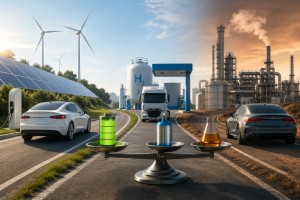
Measured by energy lost between source and wheel, direct battery-electric vehicles are hard to beat. Charging and discharging a lithium battery retains roughly 77–85% of the original electricity. Converting that same electricity into hydrogen via electrolysis, then compressing, transporting, and running it through a fuel cell, drops usable energy to around 25–35%. Synthesizing e-fuels from renewable power and captured CO₂ fares worse still, with well-to-wheel efficiencies often below 20%.
Hydrogen’s emissions profile depends entirely on how it is produced. Grey hydrogen, derived from natural gas without carbon capture, accounts for most current supply and carries a substantial carbon footprint. Blue hydrogen adds carbon capture but rarely achieves full abatement. Green hydrogen, produced via electrolysis powered by renewables, is genuinely low-carbon, though still expensive, at roughly $4–8 per kilogram in 2024.
The Future Will Depend on Infrastructure, Policy, and Scarce Clean Energy
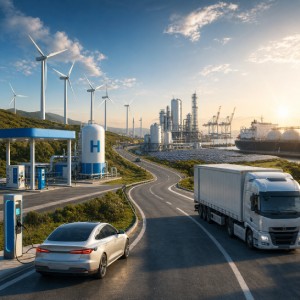
Readiness gaps, not chemistry, are what will determine whether hydrogen or e-fuels ever reach mainstream adoption. Hydrogen demands an entirely new supply chain: green production via electrolysis, high-pressure compression, cryogenic or tube-trailer transport, and purpose-built refueling stations. Germany had roughly 90 public hydrogen stations in 2023, serving fewer than 2,000 fuel-cell passenger cars. That ratio is unsustainable at scale.
E-fuels sidestep some of those logistics by using existing petrol infrastructure, but their production appetite for renewable electricity is enormous. Producing one litre of synthetic fuel requires approximately 6–9 kWh of electricity, making it far less efficient than simply charging a battery electric vehicle with the same power.
Policymakers are already making hard choices about where scarce clean electricity goes. Heavy freight, maritime shipping, aviation, and industrial heat processes consistently rank ahead of passenger cars in national hydrogen strategies, including those of Japan, the EU, and Australia.
Neither pathway offers a straightforward replacement for petrol at scale. Both remain expensive, carbon-intensive without abundant clean electricity, and dependent on infrastructure that does not yet exist in meaningful volumes. Some might argue that technological progress will close these gaps quickly, but the evidence from current deployment rates suggests otherwise. Strategic roles for hydrogen and e-fuels are plausible, particularly in sectors where electrification is impractical, but the passenger car market will require rapid, coordinated improvements across economics, carbon intensity, and physical infrastructure before either fuel can genuinely compete.
Not Every Petrol Substitute Is Equally Viable
There have been decades of research on alternatives to fossil fuels. However, the nearness to commercial realization differs widely among them all. Hydrogen has the potential of being a truly long-term solution, especially for heavy transport, but the cost of production is a headache itself. As of now over 2024, green hydrogen is one of the sorts of hydrogen being supplied globally, though via electrolysis that is powered by the renewable energy sources-only less than 1% of hydrogen supply. Support for e-fuels from political leaders in Europe is one thing, but the energy conversion losses make this approach less optimal for use in mild-to-heavy motor vehicles, because there are battery electric vehicles (EV) on the road, which are presently more acceptable on market terms. It would be logically precise to say that every solution pathway has reason to exist, albeit in certain circumstances and not everywhere. Governments who wish to treat these fuel types as interchangeable are at risk of putting their money in the wrong pathways. The path beyond petrol exists…although each separate technology might lead straight to that for a different application. Choosing the right fuel for the right class-or, rather, not putting all eggs in a single basket is the very beginning of the strategy for a deep decarbonization.